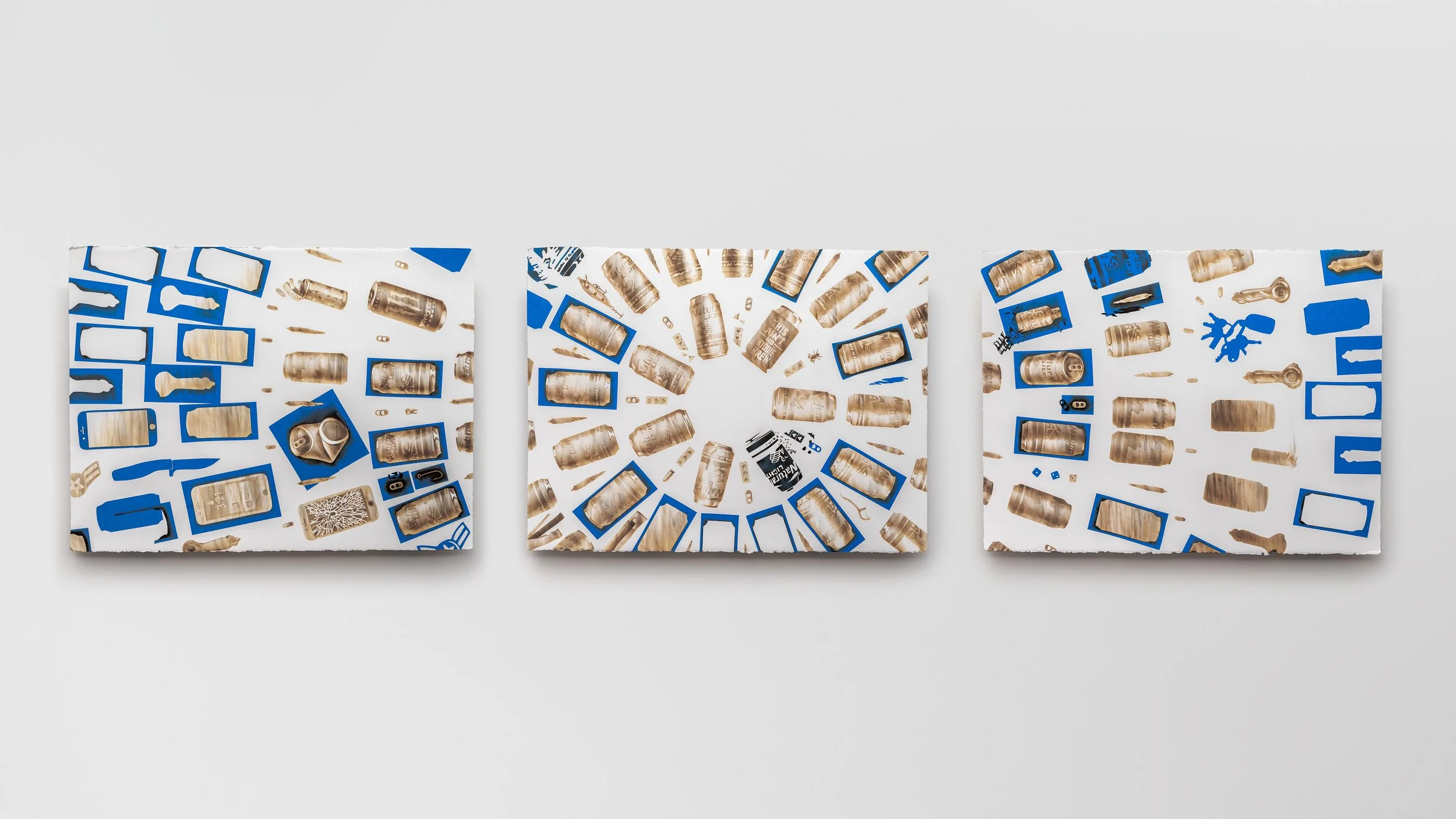
Okie from Muskogee (triptych)
Flame, smoke, and blue painter’s tape on watercolor paper
2025
23 x 96”
“Okie from Muskogee” was exhibited at Passerelle Centre d'Art Contemporain in Brest, France, as part of their exhibition “DRAW: La communauté de ceux qui n’ont rien en commun (The Community of Those Who Have Nothing in Common),” running from July 3––October 17, 2026.
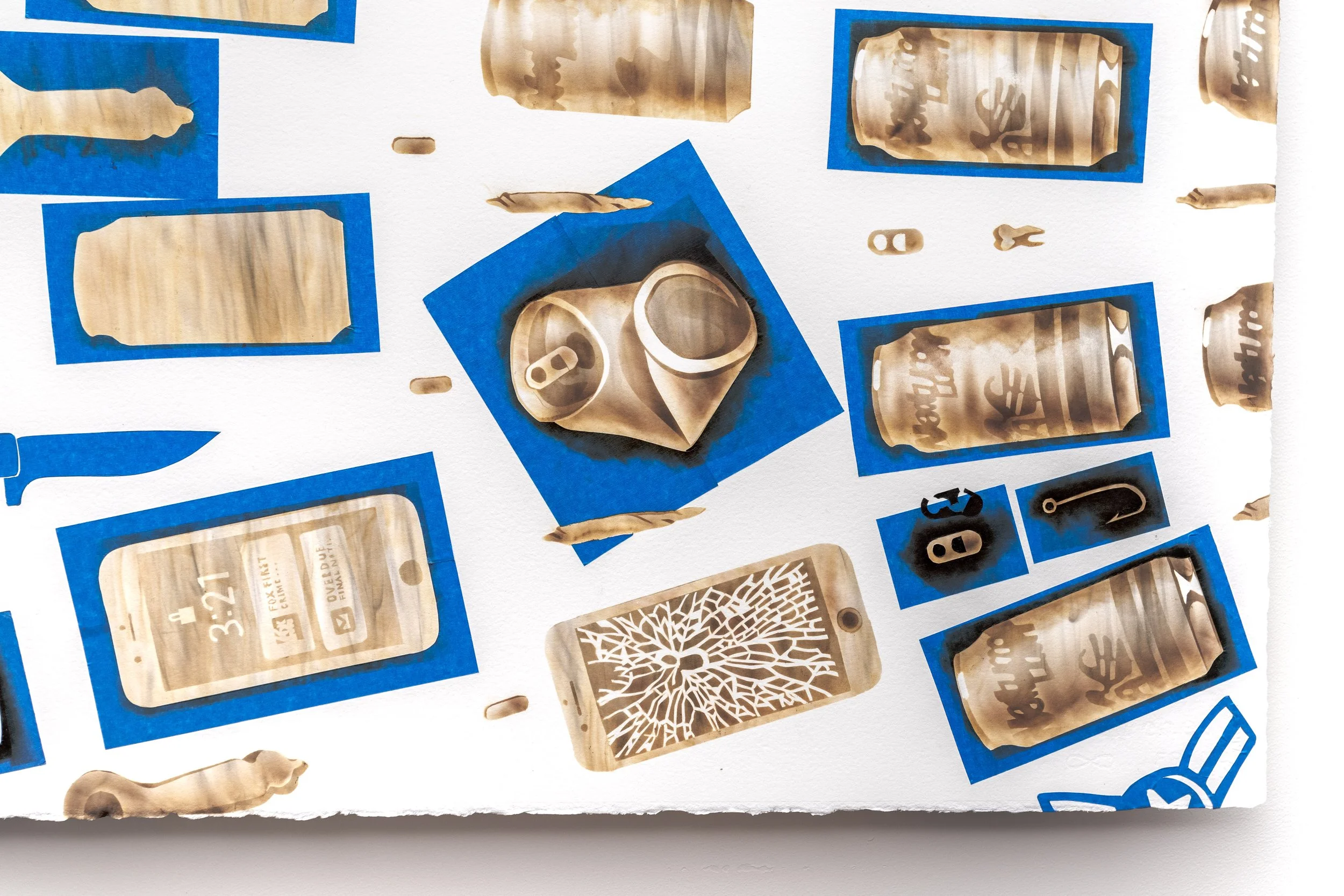
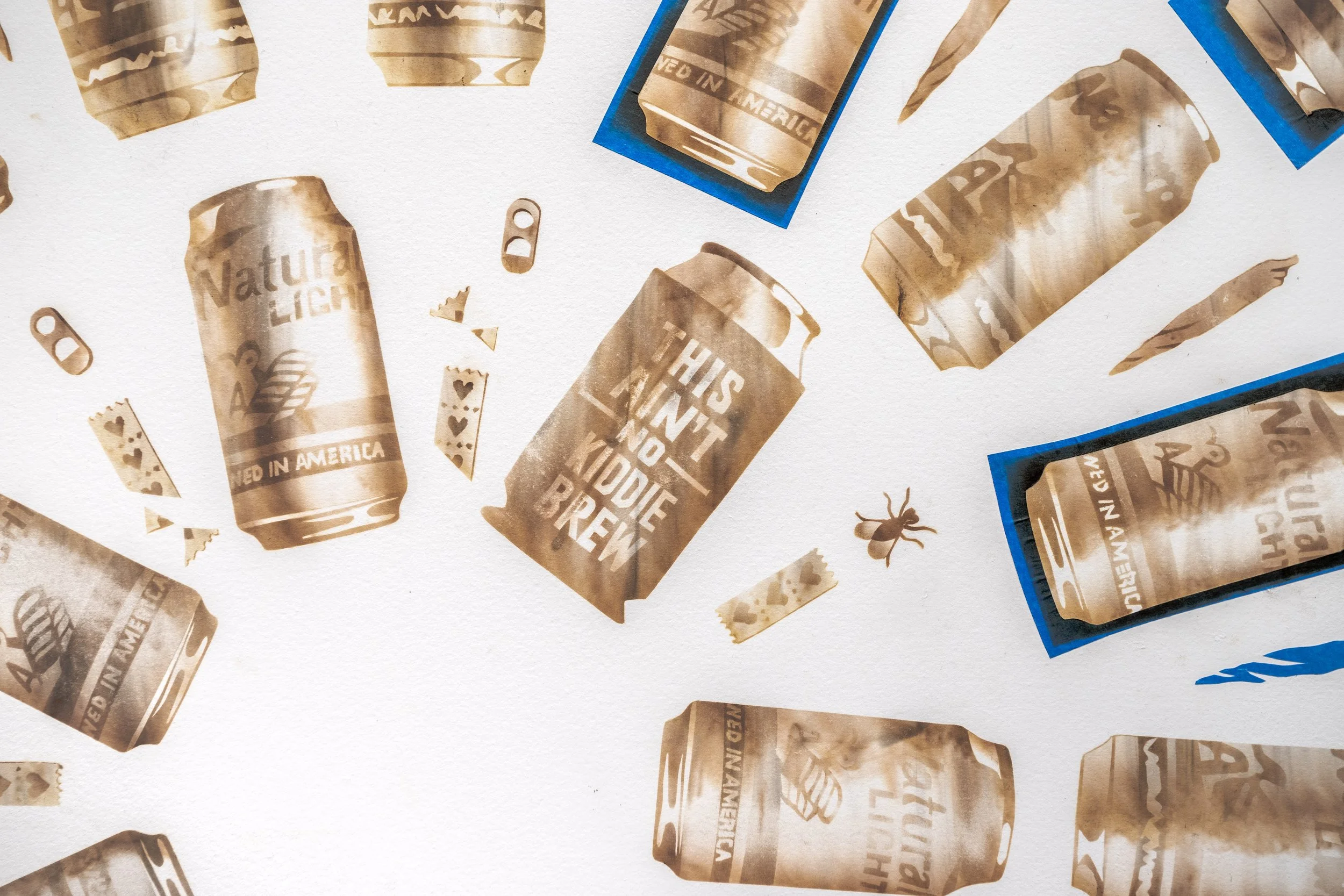
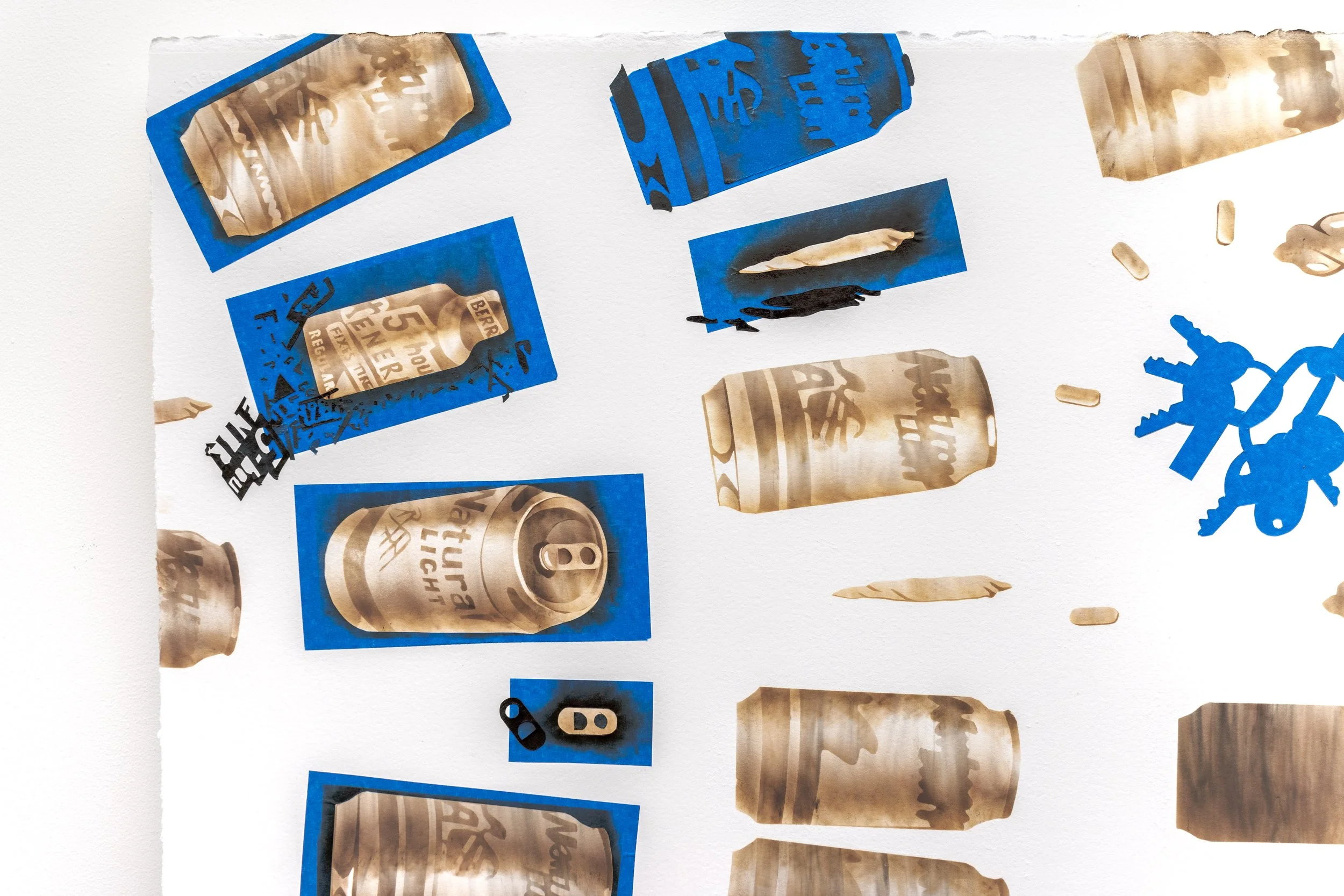
In my triptych, I return to drawing with fire and smoke, a process that has remained a recurring thread throughout my practice for more than a decade. Concentric rings of Natty Light beer cans, marijuana joints, and glass pipes radiate symmetrically from the center panel across all three panels, continuing beyond the frame as if the pattern extends without end. On closer inspection, the pattern reveals blotter tabs, energy drinks, disposable lighters, and other everyday objects from gas stations and convenience stores that complicate the mythology invoked by the work’s title. The expanding structure suggests a world shaped by repetition, habit, and proximity. By burning these images into paper, I transform an act of destruction into a record of lived experience, where fire scorches, fixes, damages, and preserves all at once.
Within the context of the exhibition “DRAW: The Community of Those Who Have Nothing in Common” at Passerelle Centre d’Art Contemporain in Brest, France, my work engages Alphonso Lingis’s writings on “the other community” and “faces, idols, fetishes.” Lingis describes community not as sameness, but as an encounter with what does not fit. In my drawings, everyday objects become small idols of comfort, compulsion, devotion, and need. The symmetry of the pattern organizes disparate objects through repetition, turning it into a metaphor for the habits, dependencies, and cycles people inherit and repeat.
The title comes from the song “Okie from Muskogee” by Merle Haggard that my father played for me as a child. The song imagines America through shared values and a clear sense of who belongs. Presented in France, the work uses the objects of my own family to reflect on a distinctly American mythology. I use it to measure the distance between that romanticized Oklahoma and the one I know now through family still living there, where older ideals remain, but daily life is shaped by generational cycles of poverty, addiction, and resilience. Like the concentric pattern itself, those cycles radiate outward through generations, carrying both love and hardship, intimacy and estrangement. They form an identity I come from but no longer fully inhabit. My work asks: What does community look like now? Who gets to belong? What holds the circle together? Who gets excluded, even within the family?