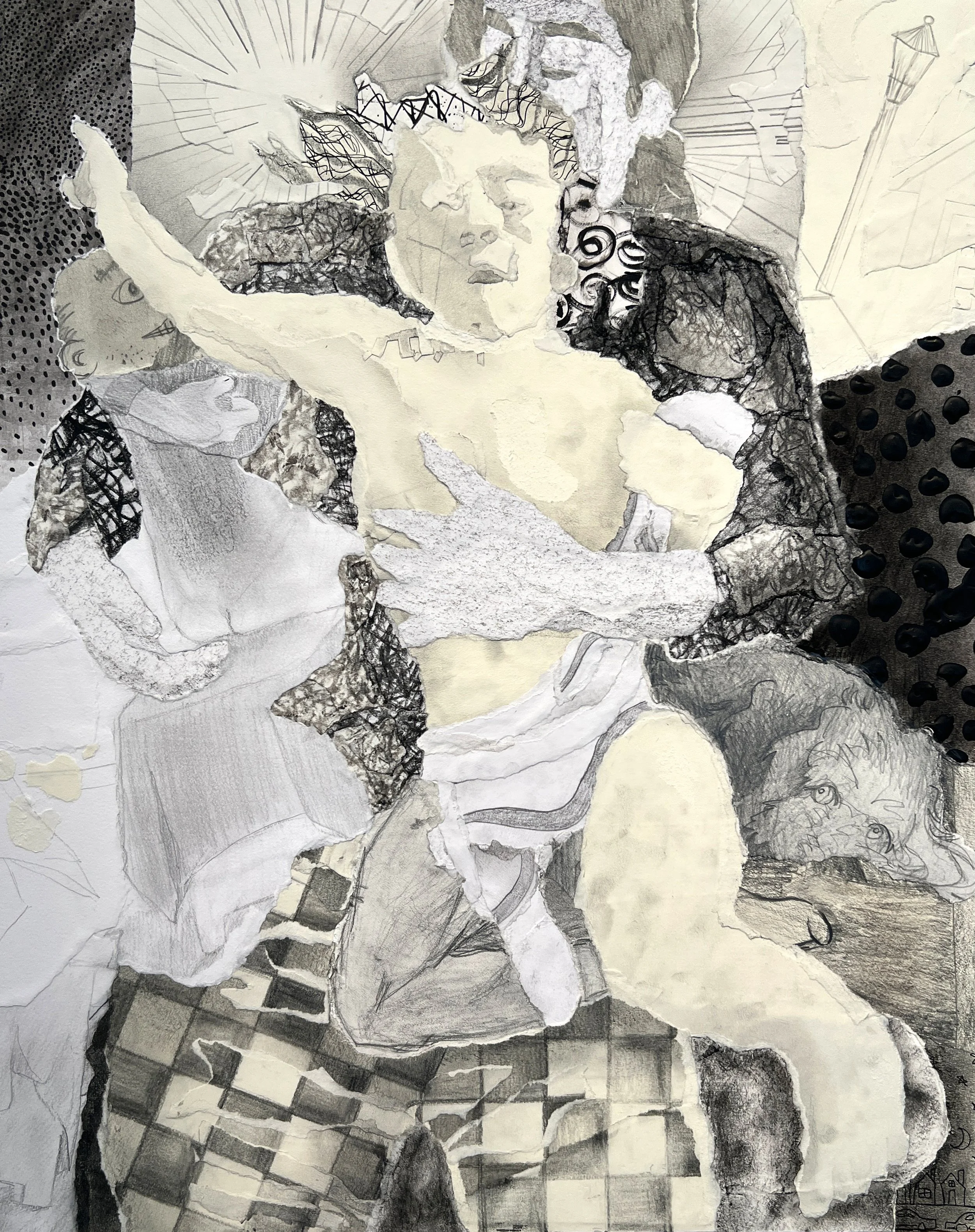
Thomas Ray Willis. “Mount Saint James” 2026. Collage of discarded student drawings (graphite, charcoal, and ink on paper). 16 × 20”
Mount Saint James
“…TO ENCOUNTER SOMETHING OF A SEQUEL [TO ‘NYU MFA ART CRITIQUE’] IN WILLIS’S OWN CONTRIBUTION TO ‘FIRST MARKS.’ IN ‘MOUNT SAINT JAMES,’ HE SHREDS DISCARDED STUDENT DRAWINGS AND REASSEMBLES THEM INTO A COLLAGE DRAWN FROM HIS PERSONAL LIFE. THE ANXIOUS, HYPER-CRITICAL MFA CANDIDATE HAS BECOME A PATIENT AND INVESTED TEACHER, BUT HE IS STILL MAKING SELF-REFERENTIAL WORK FROM THE ARTIFACTS OF STUDIO LIFE ITSELF.”
––Mike Maizels, WHITEHOT MAGAZINE, OCTOBER 2026
Collage of discarded student drawings (graphite, charcoal, and ink on paper)
2026
16” x 20”
“Mount Saint James” was exhibited in “FIRST MARKS: DRAWING IN RELATION,” the inaugural exhibition of the UMSV Art Gallery from October 20 to December 10, 2026 at University of Mount Saint Vincent in Bronx, NY.
This is the first piece I’ve shown from a series I’m developing, where I use discarded drawings from my college drawing students to make images drawn from my personal life. I collect failed exercises, abandoned attempts, and drawings left behind at the end of class. I shred them until their images and authorship begin to disappear, then use the fragments as material for new drawings. The process brings together different parts of my life as an artist, teacher, and parent. As a professor, I spend my days looking at young adults learning how to see, make, fail, and start again. At home, I watch my own children grow toward that same age. Images of my children, family, surroundings, and other parts of my life emerge from the remains of other young people’s attempts.
I grew up drawing. Sketchbooks were a refuge, and being able to draw gave me an identity before I understood what an art career was. Drawing later became my education, my work, and a way to build a life and family. I now teach students to question their own images while raising children who have not yet learned to judge everything they make. A child’s awkward drawing might be saved on a refrigerator or kept in a box for decades. A college student can make a similar mark, decide it has failed, and throw it away. Somewhere between childhood and adulthood, making becomes tied to judgment, skill, ambition, and shame. I am interested in that change. I am also interested in the Western idea of the innocent child as someone who exists before this kind of judgment. I do not know if my children are innocent, or if innocence is something I place onto them through my own desire to protect and preserve them.
The shredded drawings become both material and evidence. They are records of failure, learning, labor, and time that their makers no longer value. Destroying them removes their original purpose but gives them another one. Like the fire and smoke in my earlier work, the act of destruction becomes part of making the image. The fragments surround, interrupt, and sometimes become the people, places, and objects closest to me. I grew up in a house where objects were kept because they carried memory, and much of my work has moved between keeping and letting go, cherished and disposable, destruction and preservation. Here, those questions turn toward my own life and the things I choose to hold onto. My children remain part of that, and I want to preserve them as they are while knowing that becoming a person requires failure, loss, revision, and experience. The drawings sit between those impulses. What I want to preserve is made from the evidence of what I know cannot remain unchanged.